Civil Restoration Engineering: Science and History

Restoration Engineers operate at the intersection of engineering, science, and history – often serving as consultants to architects, construction professionals, and property owners.

It is a specialized discipline that focuses on diagnosing, repairing, and rehabilitating existing structures and/or degraded ecosystems, returning them to a functional, safe, and/or natural state. Projects most frequently include assessing damage from age, decay, environmental disasters, or human activities.

INDUSTRY TRENDS

Advanced Materials and Self-Healing Systems

The development of self-healing concrete has emerged as a cornerstone of sustainable restoration, utilizing autogenous, biogenic, and chemical mechanisms to repair micro-cracks without human intervention (Jose, 2026). Biogenic healing, in particular, employs bacteria embedded in the concrete matrix that activate upon contact with water, producing calcium carbonate to seal fissures (Jose, 2026). Beyond concrete, the use of Fiber-Reinforced Polymers (FRPs) and shape-memory alloys has gained traction for seismic retrofitting, offering high-strength and ductile alternatives to traditional steel and timber (Tiza et al., 2024). These materials not only extend the lifespan of existing structures but also reduce the carbon footprint associated with frequent maintenance (Tiza et al., 2024).

Ecohydraulics and Nature-Based Solutions

In the realm of water and coastal infrastructure, restoration is increasingly guided by ecohydraulics, a field that bridges hydraulic engineering with ecological outcomes (Baki, 2025). Recent studies highlight the use of nature-based solutions, such as instream boulders to create turbulent-flow habitats and vegetation to stabilize riverbanks affected by sediment mining (Baki, 2025). These interventions are designed to restore biodiversity and habitat connectivity while providing functional services like coastal wave attenuation and flood risk reduction (Baki, 2025). By mimicking natural processes, engineers can create more robust systems that align with global ecosystem restoration goals (Baki, 2025).

Mantoloking Bridge, NJ (County Route 528), spanning Barnegat Bay, Ocean County, NJ

Digital Twins and AI-Driven Monitoring

Think breaking points in a structure. The integration of Digital Twin (DT) technology and Artificial Intelligence (AI) is revolutionizing structural health monitoring (SHM). A Digital Twin serves as a dynamic, data-driven replica of a physical asset, allowing for real-time monitoring and predictive maintenance (Scolamiero, 2026). By combining IoT sensors, drone imagery, and AI algorithms, engineers can detect minute structural deterioration or corrosion early in their development (Alshaikh, 2025). Recent frameworks have successfully applied these technologies to complex assets like dams and urban road networks, moving the industry toward “predictive intervention” rather than reactionary repair (Singh et al., 2026; Scolamiero, 2026).

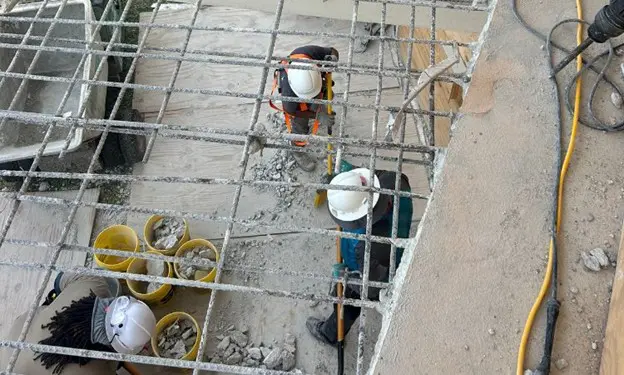
Ultra-high Performance Concrete (UHPC). Photo compliments of Rutgers CAIT

Sustainable Cementitious Composites

Recent breakthroughs in Engineered Cementitious Composites (ECC) focus on replacing traditional components with sustainable alternatives like quarry dust and supplementary cementitious materials such as fly ash and silica fume (George, 2026).

These high-performance repair mortars exhibit superior ductility and crack-width control, making them ideal for rehabilitation in aggressive environmental conditions (George, 2026). Research published in 2026 underscores that these modified ECC mixes significantly reduce primary raw material extraction and environmental ecotoxicity while maintaining the mechanical integrity required for structural restoration (George, 2026).

For decades, Morgan Engineering has been operating in restoration engineering and helping commercial and residential clients efficiently achieve pre-damage condition and prepare for the future. If you have a structural issue that may constitute restoration engineering, please contact Morgan Engineering & Surveying today as we may be able to assist.

References

  • Alshaikh, I. M. H. (2025). Pioneering the future: AI’s impact on civil engineering research. Advances in Structural Engineering, 28(9), 1515–1541.
  • Baki, A. B. M. (2025). Guest Edited Collection: “Ecohydraulics” in river and coastal restoration. Scientific Reports.
  • George, M. (2026). Life cycle assessment and structural evaluation of sustainable and cost effective engineered cementitious composite (ECC) repair mortars. Frontiers in Built Environment.
  • Jose, A. S. (2026). Advancements and Applications of Self-Healing Concrete for Sustainable Infrastructure. EPJ Web of Conferences.
  • Scolamiero, V. (2026). A BIM-Based Digital Twin Framework for Urban Roads: Integrating MMS and Municipal Geospatial Data for AI-Ready Urban Infrastructure Management. Remote Sensing.
  • Singh, P., Ge, L., Sankar, G., & Sadhu, A. (2026). Digital Twinning Framework for Advanced Remote Dam Monitoring using Internet-of-Things. Canadian Journal of Civil Engineering.
  • Tiza, M. T., Imoni, S., Akande, E. O., Mogbo, O., Jiya, V. H., & Onuzulike, C. (2024). Revolutionizing Infrastructure Development: Exploring Cutting-Edge Advances in Civil Engineering Materials. Recent Progress in Materials, 6(3), 1-68. https://doi.org/10.21926/rpm.2403023

Roof Collapse Creates Opportunity for Jersey Shore Area American Legion

Circa 2024, Morgan Engineering LLC was contacted by The American Legion Post 351 (1400 Bay Boulevard, Seaside Heights, NJ): a portion of their roof had collapsed.

Per Legion.org, “The American Legion was founded by an Act of Congress after World War I. They fiercely advocate for the unique needs of every generation of veterans, service members, and their families who pledge to protect our nation.”

Morgan Engineering heard the call and promptly put together a repair plan for American Legion Post 351. Advised Morgan Engineering’s structural engineer Patrick Laudisi, “The American Legion’s structure was seriously compromised. We listened to their goals and usage needs and Seaside Heights’ American Legion is now on its way to a fantastic, multi-use, indoor / outdoor space.”

SITUATION FUTURE (TODAY)
  • Roof collapse. Multiple structural elements compromised and interior structures subject to seasonal weather changes.
  • Building Integrity and Stability. Compromised. Overall structure posed public safety risk.
  • Debris and Safety. Drywall, insulation, timber.
  • Mold and Contamination. Open air and weather. Mold, mildew, dust: poor air quality.
  • Scaled back structure footprint to optimize outdoor space. For future development; to be used for events, social activities.
  • Efficient space usage. Damaged section was underutilized even prior to collapse.
  • Savings on MEP (mechanical, electrical, plumbing). Energy efficiency.
  • Sustainability and Site Management.
  • Less complex; futureproofing; enhanced maintainability.
WAS: Seaside Heights’ American Legion Post 351 building footprint was most all of the corner block of Bay Blvd. and Carteret Ave. in northwest Seaside Heights. NOW: Seaside Heights’ American Legion Post 351 now has significant outdoor space facing the Barnegat Bay and actively redesigning reduced indoor space for optimized year-round use by Legion members and guests.

Morgan Engineering LLC Designs 500+ Foot Retaining Wall

Morgan Engineering LLC Designs 500+ Foot-Long Retaining Wall to Facilitate Warehouse Construction and Improve Site Usability

A modern warehouse is more than just a mass structure that houses materials and equipment – it is a process that begins with vigorous, comprehensive location site analysis that includes soil testing, load and earth pressure calculations, and stormwater management.

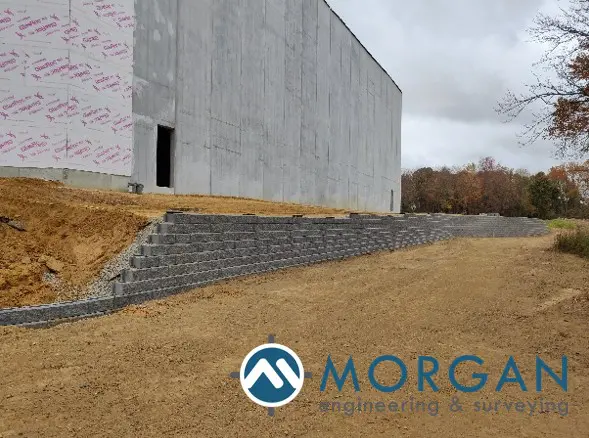
Structural Engineer Patrick Laudisi of Morgan Engineering recently completed the design and implementation of a 507-foot long by 8-foot-high retaining wall adjacent to a 141,000 square foot new warehouse construction in northern Ocean County, NJ. From base to cap, the wall includes structural components, a comprehensive drainage system, and substantial reinforcement and anchoring tools and techniques.

Morgan Engineering understands that warehouses must be designed and built to support and withstand heavy inventory, machinery, vehicle traffic, and varying weather conditions. A modern warehouse must be designed by professional structural and geotechnical engineers with the design knowledge to include reinforcement systems and drainage systems to provide a stable base and ensure the structures stand tall for lifetimes.

PHOTO: Designed to protect a warehouse from soil failure, a section of Morgan Engineering LLC designed 507-foot-long by 8-foot-high retaining wall with man atop.

Advised structural engineer Patrick Laudisi, “This was a long, windy-type structure that demanded installation precision as the site utility relies on the layout of the wall, creating the landscape that allowed the site to be developed to the extent desired. We are very happy with the outcome and we are confident its purpose has been achieved for our clients.”